
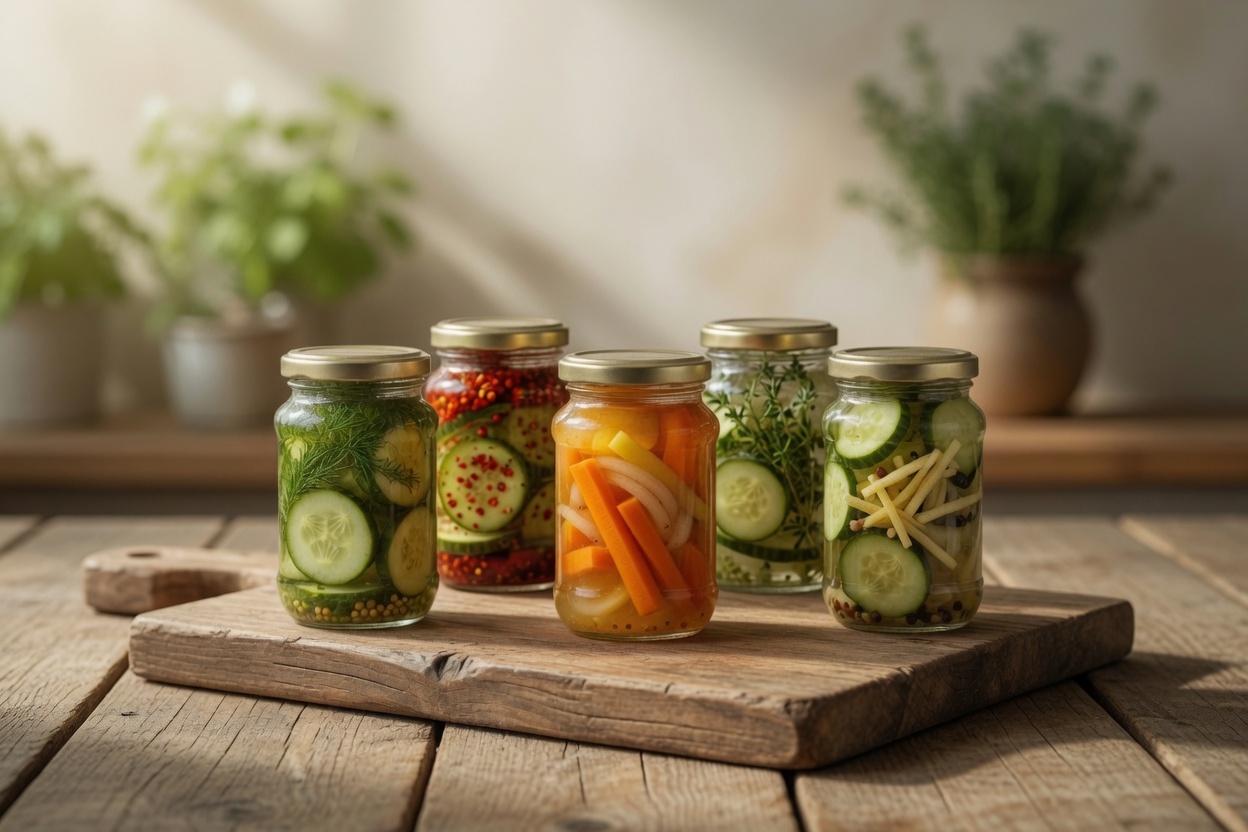
It is so satisfying to open the fridge and spot a jar of something you made yourself. A quick fridge pickle is exactly that – a small, tangy treasure that transforms a humble vegetable into something special. It requires no special equipment, no boiling water baths, and almost no effort. Yet it delivers crisp, flavorful pickles in as little as 24 hours.
Summer is the season of abundance. Cucumbers appear in overflowing baskets at the market, radishes pop up in the garden, and courgettes multiply faster than you can eat them. Making a quick fridge pickle is the perfect way to capture that abundance and enjoy it for weeks to come. A jar of homemade pickles adds a bright, acidic crunch to sandwiches, salads, and simple meals. It is a small act of preserving that feels both practical and deeply satisfying.
This no‑fuss recipe works for cucumbers, radishes, courgettes, and many other vegetables. It is flexible, forgiving, and endlessly adaptable. Once you learn the basic brine formula, you can pickle almost anything.
If you enjoy preserving summer’s bounty, you might also like our guide on making your own dried herb bundles from the June garden HERE.
What is a quick fridge pickle?
A quick fridge pickle, also known as a refrigerator pickle, is simply a vegetable that has been soaked in a vinegar‑based brine and stored in the fridge. Unlike traditional canned pickles, which require heat‑sealing and long‑term storage, a quick fridge pickle is ready to eat within a day or two and stays crisp and fresh for weeks.
The process is wonderfully simple. You prepare a brine, pour it over fresh vegetables, and let the fridge do the rest. No canning, no sterilising, no complicated equipment. The result is a crisp, tangy, perfectly seasoned pickle that tastes like it has been brined for days.
The basic brine formula
The beauty of a quick fridge pickle is that you do not need a precise recipe. Once you understand the basic ratio, you can adjust it to your taste and use whatever vegetables you have on hand.
A good starting point is the classic 3‑2‑1 ratio: three parts vinegar, two parts water, and one part sugar. For a savoury pickle, you can reduce the sugar or omit it altogether. For a sweeter pickle, increase the sugar. Salt is essential for flavour and crispness.
Basic brine recipe (for one large jar):
- 1 cup white vinegar (or apple cider vinegar)
- 1 cup water
- 1 tablespoon sugar
- 1 tablespoon kosher salt
This ratio is a reliable starting point. You can scale it up or down depending on how many jars you are making and how strongly flavoured you like your pickles.

How to make a quick fridge pickle – step by step
The method is almost as simple as the brine.
Step one: prepare your vegetables
Wash your vegetables thoroughly. Slice them into your preferred shape – rounds, spears, ribbons, or thin slices. Uniform pieces pickle more evenly and look more beautiful in the jar.
For cucumbers: Use small, firm cucumbers for the best crunch. Slice into rounds, spears, or leave whole if they are small enough.
For radishes: Slice thinly. They pickle quickly and develop a beautiful pink hue.
For courgettes: Slice into rounds or thick ribbons. Courgettes absorb the brine beautifully and remain pleasantly crisp.
Step two: pack your jar
Place your sliced vegetables into a clean glass jar. Add aromatics to the jar for extra flavour – garlic cloves, fresh dill, peppercorns, mustard seeds, or chilli flakes all work beautifully. Pack the vegetables tightly but without squishing them.
Step three: make the brine
In a small saucepan, combine the vinegar, water, salt, and sugar. Heat gently, stirring until the salt and sugar have dissolved. You do not need to boil it for long – just enough to dissolve the solids.
For an even simpler version, you can use a cold brine. Simply whisk the ingredients together in a bowl until dissolved, then pour over the vegetables. This method is quicker and keeps the vegetables extra crisp.
Step four: pour and chill
Pour the brine over the vegetables, ensuring they are fully submerged. Leave a little space at the top of the jar. Allow the jar to cool to room temperature, then seal and refrigerate.
Step five: wait (just a little)
A quick fridge pickle is ready to eat in as little as 12 hours, but the best flavour develops after 24 to 48 hours. The longer they sit, the more the flavours meld. They will keep in the fridge for several weeks.
Which vegetables work best?
Cucumbers are the classic choice, but a quick fridge pickle works with almost any vegetable.
Radishes take on a beautiful pink hue and develop a mild, tangy flavour. They are ready in just a few hours and add a lovely crunch to salads and sandwiches.
Courgettes absorb the brine easily and remain pleasantly crisp. They are a wonderful way to use up a summer glut. Slice them thinly for the best texture.
Other excellent options: Carrots, red onions, cauliflower, green beans, and bell peppers all take well to quick pickling. You can even pickle fruits like peaches and pears.

Flavour variations to try
Once you have mastered the basic brine, experiment with different flavour combinations.
Classic dill: Add fresh dill, garlic cloves, and black peppercorns.
Spicy: Add red chilli flakes or a fresh chilli.
Sweet and sour: Increase the sugar and add a pinch of allspice or cinnamon for a bread‑and‑butter style pickle.
Herby: Add fresh thyme, rosemary, or tarragon.
Asian‑inspired: Use rice vinegar instead of white vinegar, and add a slice of ginger and a star anise.
The possibilities are endless. A quick fridge pickle is a canvas for your creativity.
A few kind notes for your pickling journey
- Use fresh, firm vegetables. Soft or overripe vegetables will not stay crisp.
- Salt matters. Use kosher salt or pickling salt. Table salt can make the brine cloudy.
- Keep them submerged. If vegetables float above the brine, use a small weight or a piece of onion to hold them down.
- Store in the fridge. These pickles are not shelf‑stable. They are meant for casual snacking and should be kept refrigerated.
A quiet invitation
Making a quick fridge pickle is one of the simplest and most satisfying ways to preserve the flavours of summer. It takes almost no time, uses ingredients you already have, and rewards you with weeks of crisp, tangy goodness.
This week, I invite you to try it. Gather a few vegetables from your garden or the market. Mix a simple brine. Fill a jar. And in a day or two, you will have something delicious that you made with your own hands.
Save this post for your next summer harvest. 📌
👇 What vegetable will you pickle first? Share in the comments below or tag me on Instagram @sophiasquietcottage.


